You are here:   Cambria > Past Events > 1861 Ebensburg Alleghanian
Past Events

EBENSBURG ALLEGHANIAN
EBENSBURG, PA
DECEMBER 1861

The Alleghanian, Ebensburg, Pa.
Thursday, December 5, 1861
Volume 3, Number 11
Contributed by Patty Millich


NEWS

Local and Personal

Interesting Event!

First Arrival on the Ebensburg and Cresson branch!

Our Railroad a Myth no Longer but a Cheering Reality! And so on ad infinitum, in strains of Resplendence and Glorification to the end of the chapter.

“Hope deferred maketh the heart sick,” they say. All of which assertion we heartily endorse. We have been there ourself and are posted. Listed: Five years ago or thereabouts, the project of a Railroad hence to Cresson, an artery to connect us with the great throbbing heart of the Nation, was first currently broached in our midst. The project to use an expressive term, “took” amazingly. Everybody said it was just the thing and everybody favored it accordingly. So in due course of time the initiatory steps in the matter were taken. Just then, however when the enterprise was in its incipient stages and before it had assumed well defined shape or form, just then the Great Financial Crisis of ‘57 burst upon us. This of course knocked our Railroad into a cocked hat, metaphorically speaking for the time being. But by and by Confidence became in a measure restored and the wheels of Enterprise began once more to revolve throughout the length and breadth of the land. Again was the matter taken hold of, in earnest, and pushed on, on, on, ultimately to completion. It took time to do this, days and months and years, and Legion was the name of the difficulties and mishaps that had been encountered. It is unnecessary to here go into detail as to what these drawbacks may have been; suffice it that through their influence we were allowed a very long time to alternate between the conflicting emotions of Hope and Despair. One day we were sure that Our Railroad was eventually To Be; another day that it had irretrievably fallen through.

But the ball had been set rolling and nothing was allowed to altogether stop its progress. It kept on its way slowly but surely and now - Our Railroad is at Our Doors!

Hurrah! Huzza! Glorissimo! So much by way of unburdening ourself of surplus and overpowering Highlariousness likewise of demonstrating that though Hope deferred maketh the heart sick, all’s well that ends well.

On last Monday morning the 2d inst., at precisely the hour of 11:15, the Iron Horse made its grand entrée into Ebensburg for the First Time! Attached to the aforesaid Iron Horse was a car filled to overflowing with passengers. Since then it has made two round trips per day, each subsequent trip giving evidence that the Road will meet the fullest expectations, both financially and practically of all concerned.

Jubilante! Our Railroad is actually in full tide of successful operations! It is an Institution! It smiles blandly on us and beckons us forward to more extended fields of Usefulness and Prosperity. What more need we say? Nothing at present, for we can add nothing to the above glorious fact.

Mr. A. B. Scott, an attaché of the Pennsylvania Railroad is acting Conductor of the train. He is a gentleman in every sense of the word and will do honor to the responsible post to which he has been assigned. Success to him!

In this connection we beg leave to suggest that the thanks of our entire community are due the Managers and other officials of the Road, to the Pennsylvania Railroad Company and to all other individuals whom may have directly or indirectly lent a helping hand for the efficient manner in which the enterprise has been brought to a consummation. May they all reap their rich reward!

In town on Monday our able and efficient State Senator, Col. L. W. Hall of Altoona.

En & Cresson Railroad

Until further notice is given, the following will be the time of arrivals and departures on the railroad:

Leave Cresson at 9:30 A. M. or on departure of Express Train West.
Arrive at Ebensburg at 10:30 A. M.

Leave Ebensburg at 2:15 P. M., connecting with Mail train West.
Arrive at Cresson at 3:15 P. M.

To the Ladies

Through the kindness of Lieut. Robert A. McCoy, we have been furnished with the following Resolution, passed by the Cambria Guards at roll call on Monday evening, 25th ult. It will explain itself:

Resolved: That the thanks of Co. A, 11th regiment P. R. C. are due and are hereby tendered to the “Ladies’ Hose Society,” of Ebensburg of their timely donation of one pair of good woolen Socks to each member of the Company. Their kindness will ever be gratefully remembered.

After the passage of the resolution, three cheers were given by the company for the Ladies of the Hose Society.

Fifty-Fifth Regiment

The following are the several companies composing the 55th Penna. Regiment, Col. Dick White, now stationed at Fortress Monroe; Col. Richard White of Cambria county; Major John Miller of Bedford county; Company A., Capt. Carroll of Cambria county; Company C, Capt. O’Connell of Cambria county; Company D., Capt. Lyons of Bedford county; Company E, Capt. Bennett of Cambria county; Company H., Capt. Mullen of Bedford county; Company I, Capt. Maynard of Bedford county; Company K, Capt. Filler of Bedford County.

Off For the Wars!

On Tuesday morning the celebrated, “Silver Grays,” to the number of about sixty, departed from Wilmore this county for Harrisburg where they will immediately go into camp and recruit their ranks to the maximum standard. We were down to see them off and can truly say that a nobler or more patriotic body of men has never fallen under our observation. The fact of their offering their services to the Government when each and every member is past the meridian of life is a surrender of the pure and holy love of country that animates their bosoms. All honor to the Silver Grays, say, we, and may a just God watch over and protect them and guide them safely through whatever difficulties or dangers there may be in store for them.

New County Officers

We forgot to notice last week that Peter J. Little, our newly elected County Commissioner had been sworn into office vice Abel Lloyd whose term has expired. Mr. Lloyd performed the duties of the office with energy and ability and carries with him in his retirement the good wishes of the people of the county. Mr. Little is a practical business man and will make an acceptable officer. The present Board of Commissions stands thus: Dr. D. T. Storm; Jas. Conrad; Peter J. Little; Clerk, Charles D. Murray.

On Monday H. C. Devine assumed the duties appertaining to the office of Associate Judge in room of Hon. R. Jones who had filled the position with credit during the term of five years. Both parties have our best wishes for their success.

- - - - -

The following mention of Capt. Williams’ regular infantry company recruited almost entirely in this county will prove interesting to many of our readers.

It is taken from the Indianapolis JOURNAL, at which city the company is now stationed:

Capt. Williams’ Company of Regulars ~ This splendid body of men of the 19th U. S. Infantry, paraded through our streets on Thursday afternoon in full dress uniform with their new arms, the rifled musket.

This is a magnificent weapon and the men are worthy to handle them. In a notice of this company which appeared in our columns a few days since, we inadvertently remarked that the company was recruited in this and Michigan City. We have since learned that it is composed exclusively of young men from Cambria and Somerset Counties in the mountain districts of Pennsylvania, recruited by Capt. Williams in just one month. We rarely see this sort of men in the ranks, but Captain W., who perhaps has not his superior as an officer in the army of the Union, possesses the entire confidence of his men who are determined to be regular soldiers.

The other commissioned officers of this company are First Lieutenant Louis T. Snyder and Second Lieutenant John B. Hays, also Pennsylvanians, making this a Pennsylvania company all through. It will leave for Kentucky in a few days. Pennsylvania furnished a regiment for California - the late lamented Col. Baker’s comrades and she is now sending men to Indiana, having more than filled her quota of volunteers. It seems that she is also determined to fill up the regulars! Bully for Pennsylvania!

Pennsylvania

The Keystone State is nobly represented in the Union army. She has now more than one hundred regiments in the field and there are others prepared to enter the service. They are participating in all the great movements of the war. They form part of the army in Kentucky and are ready to join in the grand advance against the rebels in Tennessee. They are represented by the “Roundhead Regiment” at Port Royal and by troops connected with the new naval expedition about to set sail from Annapolis. They are to be found along the line of the Upper Potomac, in the rear of Washington, and they form one of the most gallant and important divisions of the grand army which now occupies the northern part of Virginia, opposite the capital. The honor of our noble Commonwealth is safe in their hands. We feel that whenever they are called into action they will prove by their zeal and courage in fighting for the union that, in this hour of national peril, Pennsylvania is more than ever, “The Keystone of the Federal Arch.”

Cambria County Millville Borough

Millville Borough was erected under the provisions of the general Borough Law in 1858 and derives its name from its principal attraction, the Rolling Mill of the Cambria Iron Company. I have a draft or diagram of it before me from the hand of that correct and careful artist, John Brawley, Esq.

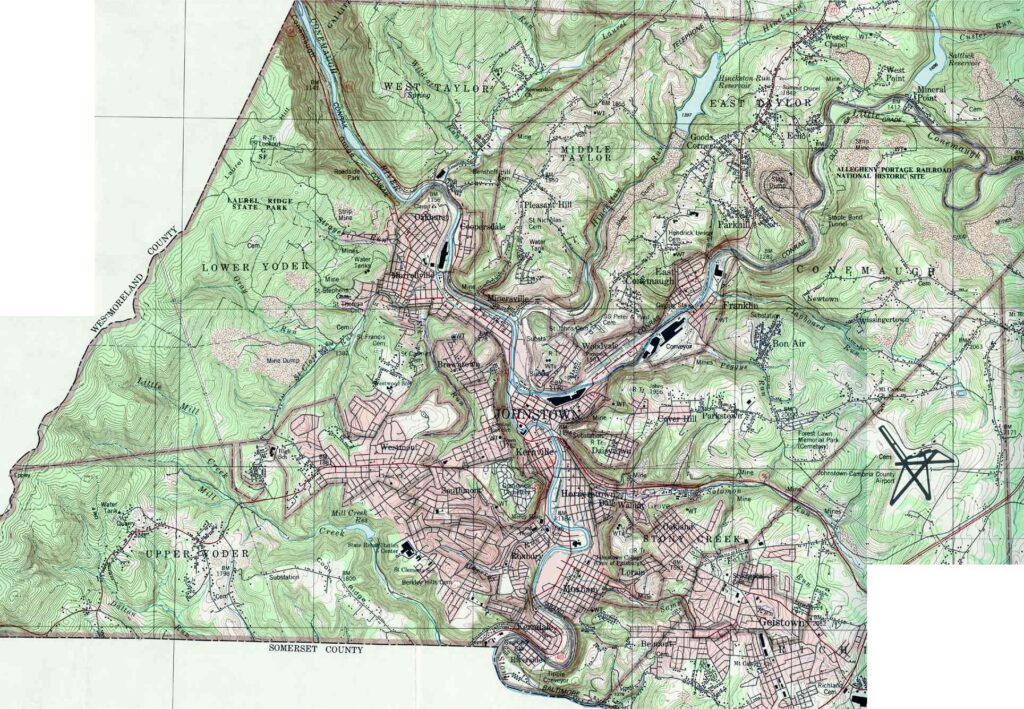
Its line commences in the middle of the Conemaugh branch of Conemaugh River, thirty perches above the aqueduct; thence crossing the Pennsylvania Rail Road and shortly after a rivulet, it passes north of Johnstown Furnace, so as to include it, and follows the brow of the hill, running nearly parallel with the river, for upwards of a mile. This line crosses Hinxton’s Run, which rises in Jackson Township, in the middle of a large island. From a point a short distance West of this stream, the line turns nearly at right angles and runs to the centre of Conemaugh river. Thence by a line following the courses of the streams in the junction with Stony Creek and following the bed of the Conemaugh branch to the place of beginning.

The number of houses is about 250; the population over 1,000. It was erected out of a portion of Taylor township, and dwelling houses principally occupy that portion of the Borough between the Conemaugh and the Pennsylvania Canal, which passes through the whole length of the village.

This town lies admirably for business and has almost unequalled advantages for manufacturing. Its whole front lying upon the Conemaugh, it has a moiety of one aqueduct, one county bridge, the rail road bridge, and a toll bridge; while it is traversed by the Pennsylvania Rail Road, the Pennsylvania Canal and public roads to Ebensburg and Armagh. An inexhaustible bed of iron lies in the hills within the borough limits and bituminous coal of the best quality is abundant in the immediate neighborhood.

The Station House and Depot of the Pennsylvania Rail Road Company for Johnstown and the surrounding country are within Millville Borough, a station furnishing more travel and shipping, more merchandise and produce than any between Pittsburg and Harrisburg.

On the opposite side of the Canal from the Station are the works of the Johnstown Iron Company, owned by Mr. Christian Hinsen of Pittsburg and under the Superintendence of John Crouse, Esq. Johnstown Furnace is a fine structure and of great capacity but has not been working or run for several years.

But the principal attraction of Millville Borough and which overshadows everything else is the Works of the Cambria Iron Company. And as this will require at least a separate paper I shall defer it till my next chapter. Signed: Jonathan Oldbuck, Monkbarns, December 5, 1861.

List of Letters

Remaining in the Post Office, at Ebensburg, Cambria Co., Penna., Nov. 13, 1861:

Jane B. Davis
Miss Eliza E. Davis
Joseph G. Bridges
Lewis Beynon
William Byrns
Daniel Donaldson
John Denning
Evan E. Davis
Anna Maria Davis
Elizabeth E. Davis
Evan T. Davis
Thos. E. Davis
Margaretta Evans
Evan J. Evans
Miss Emley Evans
Mrs. Eliza G. Evans
Mr. J. Evans
Thos. Empfield
Ephriam Gohanour
Soffy Hite
Miss Mary Jones
Samuel D. Jones
John A. Jones
Daniel T. Jones
Mrs. Jane Jones
T. I. James
Mrs. Catharine Jones
Miss Ellen Kennedy
Mrs. Margaret Lloyd
Miss Mary F. Lewis
Mrs. Elizabeth Morgan
Patrick Malloney
Miss Maggie McConnell
Mrs. Elizabeth Patterson
Miss Sarah Perkins
Samuel H. Rossman
J. T. Richardson
Geo. M. Rhay
E. J. Roberts
William Selders
Francis Stittmatter
Andrew Shoemaker
Jacob Settlemyer
Joel Simmons, James Duncan, David Todd and David H. Roberts
David E. Thomas
Miss Ann Thomas
David Wilson
Thos. Walker
Jos. T. Williams
Thos. M. Williams
Geo Walters
Miss Julia Ann Williams
E. Williams

Persons calling for any of the above named letters will please say they are “advertised.”

John Thompson, P. M.

DEATHS

Died at the residence of her grandparents in Carroll township, Nov. 26th of diphtheria, Elizabeth Capitola, youngest daughter of Elias and Ellen Edmiston, aged 2 years and 6 months.

Died at the house of John Edmiston in Carroll township, November 28th, of diphtheria, John McCahen, aged about 12 years.


The Alleghanian
Ebensburg, Pa.
Thursday, December 12, 1861
Volume 3, Number 12
Contributed by Patty Millich

NEWS

The War Department, it is reported, is convinced that Gen. Scott was right in rejecting the offers of cavalry regiments for the war. It is found that raw mounted troops are of very little use for active service.

Enoch Lewis, Esq., General Superintendent and W. H. Wilson, Esq., Resident Engineer of the Pennsylvania Railroad both of Altoona were in town on Saturday last.

The Stars and Stripes now wave in seven of the seceded states, to wit: In North Carolina, over Fort Hatteras; in South Carolina, at Beaufort; in Georgia, at Fort Tybee; in Florida, at Key West and Fort Pickens; in Mississippi, at Ship Island; in eastern Tennessee and in the northern and western sections of Virginia. The Union Flag also waves, we suppose, in some parts of Texas and hundreds are hidden away but worshipped secretly in every secession state.

Government has given orders for the manufacture of half a million pairs of woolen mittens for the use of the brave soldiers who are now battling for our national existence. This is good news for the soldiers.

The Fate of a Traitor

It is with a great deal of pleasure that we note the expulsion of John C. Breckinridge from the United States Senate. A resolution for that purpose was offered by Mr. Chandler of Michigan on the 4th inst., when Mr. Powell of Kentucky took the ground that inasmuch as Breckinridge had resigned, he could not be expelled. Mr. Trumbull of Illinois insisted however that he should be expelled and offered a substitute for Mr. Chandler’s resolution in the following pithy language:

Whereas, John C. Brickenridge, a member of this body, has joined the enemies of his county and is now in arms against the Government he had sworn to support therefore,

Resolved that the traitor, Breckinridge, be expelled from the senate.

The substitute was accepted by Mr. Chandler and the resolution was unanimously adopted, yeas, 36, nays, none. The following gentlemen were absent or dodged the question, viz:

Messrs. Bayard, Bright, Johnson (Tenn.), Johnson (Mo.), Pearce, Polk, Powell, Rice, Sandsbury and Willey.

Thus the double traitor who has proved himself false to Kentucky and false to the Union, instead of being permitted to vacate his seat by resignation is genteelly kicked out of it by his former associates. He has brought upon himself the disgrace which his expulsion carries with it. He has received what he deserves and he deserves still more. We hope than an opportunity will yet offer, when he may be presented with a hempen neck tip and that the Federal authorities will adjust it so tightly that he cannot say “Craven,” a word which describes the despicable coward with the utmost precision and nicety.

All Hail! Silver Grays!

Last week we visited Harrisburg in company with Capt. William Palmer, for the purpose of making the necessary arrangements for having the company of the veterans known as the “Silver Grays,” ordered into service, as well as to have provision made for their being comfortably quartered and speedily uniformed. Our most sanguine anticipations were realized. We were received in the most friendly manner by Governor Curtin who gave us every satisfaction, assuring us of his cordial interest in the effort to raise a company of hardy veterans desirous of marshalling themselves under the “Stars and Stripes,” also giving his consent to all our suggestions, promising to provide for the “Old Men of Cambria” to the extent of his power. We were authorized to send on the “boys” on Tuesday. They are gone, followed by the fervent aspirations of every patriot in the county for their safety while absent and their honorable return, after the glorious Stars and Stripes once more wave proudly over thirty-four States of the Union.

We accompanied the “Silvered Patriotic Soldiers,” on Tuesday as far as Altoona. They numbered about sixty to be followed by many more during the present week who could not make it suit to go with the advance. In parting with this brave band of volunteers, who have discarded all claims to exemption from liability to military service, we were forced to the conclusion that so long as this spirit animated the Northern American heart, our old Flag and our Republican Institution could and would withstand the assaults of domestic as well as foreign foes. In extending, when parting, the hand of friendship to each one of these “old men,” we felt within us a feeling of confidence and pride which we cannot describe. God bless them! May their days be days of glory and happiness and may their end be peace.

We cannot close this brief article without saying one word of praise and commendation for the sprit and devotion which characterized the amiable lady of Capt. Palmer while the “Silver Grays,” were rendezvoused at her house. Night and day she was laboriously engaged in ministering to their wants. Every member of the company carries with him a feeling of gratitude which will live even beyond the grave. A soldier’s benedictions are hers.

It will give us great pleasure and we know it will be equally gratifying to our readers to publish from time to time “notes’ promised to be furnished us by a “Silver Gray.”

[The above was prepared last week after returning from Altoona, but too late for publication until this issue. - Ed. ALLEGHANIAN]

Local and Personal

Appointment

The County Commissioners have appointed Mr. John Farrell of Johnstown, Mercantile Appraiser of this county for the ensuing year.

Court

The proceedings of Court last week were of such a trivial and uninteresting nature that we have decided to not burden our columns with their publication.

Lyceum

The question for debate at the E. L. A., on next Friday evening is as follows: “Resolved, That the President’s Message is a sound conservative document.”

Gone

We hare sorry to chronicle the removal from our midst of our friend, Clinton R. Jones, who, with his family, has gone to try his fortune in Western Virginia. May success attend him!

In Town

Our friend, Geo. Barrett, Esq., now engaged as Assistant Engineer on the Reading Columbia RR has been spending a few days in town this week. He looks well and is one whom we are always glad to meet.

Personal

Col. John M. Bowman, editor of the Johnstown TRIBUNE, was in town on Tuesday and dropped in to see us. He appears to bear the crosses of editorial life about as well as the next one. Long life to him!

Installation and Retirement

Mr. John Buck, the newly elected Sheriff of this county was sworn into office yesterday. Although we opposed his selection on political grounds, still we are confident in predicting that he will make a popular public official.

R. P. Linton Esq., the outgoing Sheriff, has filled his term of office with honor both to himself and the county. The thanks of the people will follow him in his **re[word unclear, may be retirement].

We tender our best wishes for the prosperity of both parties.

Cambria County
Millville Borough – Continued
Cambria Iron Works

The development of the iron resources of Cambria county is of rather recent origin and is calculated to portray the shortsightedness of man, maugre **[word typed as printed in the paper] all his scientific attainments. What now is perhaps the richest iron field in Pennsylvania was a few years since regarded as a worthless and unseemly bluff, a kind of wart on the agricultural surface of Cambria county. Nay - at an early day in our history as I have elsewhere noticed, pig metal from the valley of the Juniata was, with incredible labor and difficulty, hauled over the Alleghany Mountain by what is known as the “Frankstown Road,” a road which the progress of improvement in these latter days has left with few travelers.

Nearly a score of years since George S. King, Esq., who is entitled to the honor of first establishing iron works in Cambria county purchased the ground and commenced the erection of Cambria Furnace, stimulated by the Tariff Act of 1842. This furnace is about a mile from the canal and the Conemaugh River; and is supplied with water by a tributary of that stream. Its distance I believe is about four miles from Johnstown in Conemaugh (now Taylor) Township. The Messrs. Shryock were associated with Mr. King in this enterprise, but afterwards their interest fell into the hands of the late Dr. Peter Shoenberger. This is the oldest iron establishment in Cambria county.

At a later period Mill Creek furnace was erected on the stream of that name in Conemaugh (now Yoder) township and owned by John Bell & Co., the firm being John Bell, George S. King and Peter Shoenberger. The interest of Mr. Bell became vested in Mr. Shoenberger prior to 1850.

Still another Furnace was erected on Ben’s creek, a tributary of Stony creek, a short distance above its mouth, also in the present township of Yoder (then Conemaugh), some of the dwellings being in Somerset county. The same company owned this furnace under the firm name of Bell, King & Co. In 1850 or about that time Dr. Shoenberger became sole owner of this furnace.

The impulse that had been given to the manufacture of iron had meanwhile subsided – the business languished – and a general stagnation was the result. The worst fears were entertained for the success of these establishments and, if I remember rightly, they had (or at least some of them) suspended operations.

It was about this period (1850) that the idea of establishing the Cambria Iron Company originated. I have not the Act of Incorporation before me but think the capital stock of the Company was fixed at One Million dollars. Cambria, Mill Creek and Ben’s creek furnaces with all the lands attached to them were put into the concern at the modest sum of $100,000; this amount to be held by Messrs. King and Shoenberger in proportion to their respective interests in these furnaces.

The act of incorporation was passed by the Legislature, the charter obtained and the company forthwith commenced operations. Everything was undertaken on the most gigantic scale and the extensive works, now known as the Cambria Iron Works progressed rapidly to completion.

But reverses came. As in most undertakings of a similar character the expectations of the corporators were too sanguine, their ideas of success were not realized; the stock went down to nominal prices and ruin seemed to stare the whole enterprise in the face. Nothing but the wisest counsels could have preserved the affairs of the Company from bankruptcy as heavy liens had been entered on record for the construction of the Mill and other buildings. Happily wise counsels did prevail and the whole concern, for the purpose of a final experience, was leased to Messrs. Wood, Morrell & Co., who have conducted the works to the present time.

Signed: Jonathan Oldbuck, Monkbarns, December 12, 1861

DEATHS

We are informed that John Wise, of Chest Springs, this county, and a member of the Cambria Guards, died in camp near Washington city recently. This is the first instance of fatality that has yet occurred in the ranks of this company.


The Alleghanian
Ebensburg, Pa.
Thursday, December 19, 1861
Volume 3, Number 13
Contributed by Patty Millich

NEWS

Local and Personal

Notings [as written in the newspaper] from Western Virginia

Portland, Va., Dec. 12, 1861

Here we are – away down in Dixie Land – about one hundred and thirty-seven miles east of Wheeling and directly on the line of the Baltimore and Ohio Railroad.

You will remember that I left you on Monday. On Tuesday at about 7 P. M., I arrived at Wheeling and took breakfast at the McClure House where Gen. Rosecrans now has his headquarters. Much to my regret I did not have an opportunity of seeing that distinguished personage. The Suspension bridge here is a splendid affair. I passed through a small town named Fairmount, where there is another Suspension bridge, equal to the one at Wheeling.

I also passed through Grafton. It is located somewhat similar to Johnstown but is not so large. There is a splendid hotel at this point erected by the RR company.

The scenery all along the route is most grand. The road itself must have cost an immense amount of money in building. It winds through a very mountainous country and has a great many deep cuts. Besides there were no less than nine tunnels in the distance I traversed, one of which was about a mile long.

The 7th Ohio regiment today passed through Portland for Cumberland Gap. The prevailing impression hereabout is that a fight will occur shortly about Winchester and Leesburg and that the rebels will be driven out of our territory and that order will once more prevail in Warsaw.

There are no seseshers whatever here or in the immediate vicinity. The great body of the people are as loyal to the Union as are Pennsylvanians in general and a great deal more so than some few in particular that I could name in Cambria county had I the inclination. Signed: Uno

Letters from Our Volunteers

Extract from a private letter, dated
Camp Pierpoint, Va., Dec. 8, 1861

Up to this time the 11th regiment has been out twice, on company with other regiments on reconnoitering excursions, otherwise foraging expeditions. On the latter of these, we marched within a few miles of Drainesville, the 2d brigade in front. Our train consisted of fifty- four four-horse wagons. Companies A and B of the 11th were detailed as wagon guards, that is to say, as a guard to “confiscate” the plunder. The rest of the regiment went out as pickets and scouting parties. We met no enemy in force.

We took, I suppose, about five hundred bushels of corn, one hundred bushels of potatoes, twenty five or thirty hogs, quite an amount of wheat, an ox-team and a number of horses. Besides these several private appropriations of turkeys, chickens, ducks and other necessaries of camp life also occurred. Gunnell is the name of the late owner of the confiscated property. He is a prominent member in the Rebel Confederacy.

This is a delightful climate. The weather is warm and dry. The effective troops on this side of the Potomac are in better condition and better sprits than any time since they crossed the river. Company A, as a general thing, enjoys good health.

Silver Grays

We find the following notice concerning the Cambria County Silver Grays in the Harrisburg TELEGRAPH of Friday last:

Captain Palmer marched into the city this morning from Camp Curtin, with the view of being mustered into the service of the United States, but as the ages of the members were considerably over the limit fixed by law, the mustering officer, Capt. Dodge, postponed that duty until he received further orders from Washington. The “Grays” then returned to Camp Curtin where they will remain until the question of their acceptance is determined by the proper authorities.

Inasmuch as the formation of this company was countenanced by the State authorities, Gov. Curtin having given his express approval to it, we think it would be indeed bad policy to refuse to accept its service. The officers and members who experienced much inconvenience in the premises, got up the organization with the express understanding that it was to add its efforts to help save the Republic and their patriotic desires should not be interfered with now. We hope to hear of the Silver Grays being “sworn in” at the earliest practicable moment.

Local Etchings

The weather continues mild and pleasant in this latitude, more closely resembling Indian Summer than any season of which we have knowledge. The snow has entirely disappeared and we are obliged to send it under bare poles like good fellows.

As an instance of the benefits of advertising we may mention the fact that during the past month two stray cattle have been recovered to their owners through the instrumentality of the columns of our paper.

The Ladies’ Association

Annexed is a list of articles contained in two boxes forwarded by those good Samaritans, the Ladies’ Association of this place, to the Sanitary Commission of the War Department last week:

Four pr. Woolen Socks; one pr cotton Socks; nineteen Comforts & Quilts; one Blanket; Thirty Pillows; one hair Pillow; Eight Cushions; six double Wrappers; forty Pillow Cases; one pr. Sheets; sixteen Towels; thirty pr. Slippers; six parcels muslin Rags; four parcels Linen; ten under Shirts; thirteen pair Drawers; six Rings; seven cans Tomatoes; one can Raspberries; one can Peaches; one can Plums; one can Apples; one can Pear Preserves; one can Pumpkin butter; one can Blackberry Jelly; one jar mixed Pickles; two bottles Tomato Catsup; one bottle dried Currants; four parcels dried Fruits; five papers Corn Starch; one paper Gelatine; Magazines and Reading Matter.

Steam Saw Mill

We notice that Messrs. A. A. Barker and T. S. Robinson, the former of this place and the latter of Chest Springs are now engaged in the erection of a steam saw mill in the East Ward, directly on the line of the railroad. The building is fifty feet in length, twenty-five feet in breadth and one story high. The frame work has already been “raised,” with the prospect of a speedy completion of the entire structure in a short time. We congratulate Messrs. B. and R. on the energy and enterprise they have displayed and place on record the hope that theirs may prove a paying experiment.

RR Item

Work on the remaining section of the railroad is progressing. A large force of workmen are now employed on it and weather permitting the probability is that it will be completed in a week or two.

Postmaster Appointed

Dr. G. R. Lewis has been appointed Postmaster of Carrolltown borough, vice Wm. R. Jones, resigned. The Doctor will make an excellent official. We wish him success.

Joseph H. Sears has been appointed Post Master at Port Royal, S. C.

A Cheerful Letter

The following document, written by a Southerner in the Rebel army and published in a Southern paper, indicates a meek and Christian-like spirit:

Abington, Va., Oct. 2, 1861.

My Dear Wife: I have left you and our children in the land of the despot, but God grant that I may soon be able to make the Union men of Kentucky feel the edge of my knife. From this day I hold every Union traitor as my enemy and from him I scorn to receive quarter and to him I will never grant my soul in death, for they are cowards and villains enough. Brother Henry and I arrived here without hindrance. I have had chills all the way but I hope to live to kill forty Yankees for every chill that I ever had. I learn that Hardee is still in the Arkansas lines, inactive, and if this proves to be true, I will tender my resignation and go immediately to Kentucky. I hope I will do my duty as a rebel and a freeman. Since I hate the Union men of Kentucky I intend to begin the work of murder in earnest and if I ever spare one of them, may hell be my portion. I want to see Union blood flow deep enough for my horse to swim in. Your Husband, James Blackburn

Cambria County
Millville Borough – Continued
Cambria Iron Works

From the period at which the Cambria Iron Works passed into the hands of Messrs. Wood, Morrell & Co., the present lessees down to the present moment, they have been eminently successful. The members of this firm reside in Philadelphia, with the exception of Daniel J. Morrell, Esq., the active member of the firm, who superintends the establishment in person. Under his direction the works have been conducted prosperously, or at least successfully, for a number of years, and have withstood the monetary panics which have proved so disastrous to kindred establishments.

Upon the subject of the capacity of these works, and the modus operandi of manufacturing rail road and other iron from the raw material, I select the subjoined description written by an intelligent eye witness:

“The process of manufacturing commences with the Blast Furnaces, where the ore is reduced to pig metal. Four of these large Smelting Furnaces are situated at Johnstown, each 48 feet high, 13 feet bosh and requiring 4 steam engines, (of 200 horse power each) to produce the requisite blast, and one engine of 60 horse power to supply the water for the Boiler and Furnaces. When all is in blast, these Furnaces produce on an average, 700 tons of Pig Metal per week. To feed them requires a corresponding amount of ore and coke to the iron produced. The mountains of ore which we saw accumulating in one point and melting away in another, explained the mode of feeding these Furnaces. The ore is mined upon a level about 70 feet above the coke yard (which is on a level with the Funnel Head of the Furnace), and dumped from the cars in which it is taken from the mines in large piles or clamps, containing from 20 to 40,000 tons each. Coal being distributed amongst it as it accumulates, it is roasted or calcined in these clamps from which it is taken when properly prepared directly to the Furnaces. Four of five of these clamps are kept constantly going; while one is forming, one or two will be burning, another cooling and another being used in the Furnaces. About 3,000 tons of ore is thus mined and disposed of weekly.

“The coke is mostly made in the open air, in what is called Pits, being long piles or winnows of coal from 75 to 120 feet long, 8 feet wide and 4 feet high of which there are generally from 50 to 60 of these Pits in the process of coking.

”The Rolling Mill which is in the shape of a Maltese cross (with one additional wing, 74 feet square) is 400 feet long, the main building 100 feet wide and 370 feet across the cross wings; covering an area of 83,375 square feet, containing 30 Double, equal to 60 Single Puddling furnaces, 14 Heating Furnaces, 14 Pairs of Rolls, with all the requisite machinery, such as Fans, Shears, Saws, Punches, Presses, &c., all driven by 14 steam engines, equal to 1,000 horse power. Working capacity 600 tons per week or 30,000 tons finished rails per annum.

“Near the mill is a large foundry, which is driven by a small upright direct acting blowing engine of 30 horse power and near it a machine and blacksmith shop, having two steam engines. These shops manufacture the machinery and do all the repairs of the works. In addition to the 4 large Blast Furnaces at Johnstown, they have four others of a smaller capacity, situated at from three to twelve miles distant, the metal from which is taken to the mill by canal and wagons. Two of these working on charcoal and one on coke, are not in blast. One out of blast. The Wagon-makers shops, Harness maker shop, stables, butchering establishments, Stores and other auxiliary departments, each in themselves a respectable enterprise, all go to swell the magnitude of this mammoth concern. They fact that over 2,000 men find constant employment in and about these works, gives a better idea of their magnitude than any statistics could suggest. In addition to the ore bank at Johnstown, the company has one near Hollidaysburg from which they obtain the quantity of Fossilliferous ore wanted to work with the Johnstown Carbonates, to produce the desired quality of iron.

“The Pig Metal is taken by Railroad from the furnaces to the mill a distance of less than 1 mile, broken up and taken to the Puddling Furnaces, and there by the process known as boiling or Puddling, converted into wrought iron and formed into balls of about 100 lbs weight, which are taken to the large Rotary Squeezer (an improvement upon the Tilt-hammer), which throws off the cinders or dross and forms them into Blooms, which are taken to the Rolls and there rolled into what is called Muck or Puddler’s bar; from thence the bars are taken to the shears and cut into lengths suited to the weight of rail to be made. A portion of this iron is piled and rolled into bars of 7 ½ inches wide and 1 inch thick, which is cut by the shears into suitable lengths to form the top and bottom pieces for the Rail pile, which is made up of 5 or 8 layers of this re-worked and Puddler’s iron. The Rail pile thus made up, is heated and taken to the Rail mill which has three Rolls, one above the other and the hot iron is passed first between the middle and bottom Rolls and back between the top and middle, thus working the iron both ways, saving much hard labor in passing the iron back over the roller, as is the case in the ordinary 2 high mills and about one-half of the time usually consumed and insuring a much sounder and more perfect weld than could be procured in an ordinary mill. Ten to twelve passes, occupying about one minutes’ time, forms the rail which is run from the Rolls onto a carriage which then takes it to the saw where both ends are cut off, leaving it of the desired length. From thence it is taken to the cooling bed where it remains until cool enough to handle when the straightener takes it to the press to straighten, which done, the ends are finished by chiseling and filing them and then passed to the puncher. After being punched, they are taken outside of the mill, finished and ready to be loaded onto the cars which the company’s locomotive has ready.

“It requires about the space of time necessary to complete the process of making the Rail before it is cool and from the time the pigs are introduced into the Puddling Furnaces, the iron passes over some 600 feet of ground, until it is put into the cars in the desired shape of Rail.”

This mammoth establishment, (the largest in America and perhaps in the world), gives employment to over 2,000 men, occupying over 200 tenant homes and is it is believed the only one in our county that is now fully worked. Some ideas of its magnitude as well as the patriotism of the hardy operatives may be inferred from the fact that it has given to the Country during the last year, 600 soldiers and in the language of its liberal manager, a “large new crop of soldiers growing up for future armies.”

Signed: Jonathan Oldbuck, Monkbarns, December 18, 1861

DEATHS

Sad

On Friday night, 30th ult., a man named Wm. Hartness of Pine township, Indiana county, was frozen to death near his own residence. He had been to Armagh during the day and procuring a quantity of whiskey, he imbibed immoderately. On his way home he became stupefied and laid down by the road side where he perished from the effects of the cold and the poisonous liquor combined. So we learn from the Indiana MESSENGER.

Sad Accident

On Friday of last week, a man named Michael Burgoon of Washington township, this county, was killed near Cresson under the following circumstances: He was engaged at the time as fireman on the Pennsylvania Railroad and had occasion to get off his locomotive at the above point. A train, then due, the approach of which was not noted by him, came down the track on which he was standing, and striking him, killed him almost instantaneously. His head was cut almost in twain and he was otherwise mutilated. The remains of the unfortunate man were interred at Wilmore on Sunday.


The Alleghanian
Ebensburg, Pa.
Thursday, December 26, 1861
Volume 3, Number 14
Contributed by Patty Millich

NEWS

Local and Personal

Letters from Our Volunteers

Camp Pierpoint, Va., Dec. 13, 1861

Our division was out on two foraging expeditions last week in the neighborhood of Drainesville, eleven miles from our camp. The First brigade had the advance expedition and Second - a part of which the 11th regiment forms,- as a reserve. The expedition succeeded in “cabbaging” about sixty wagon loads of wheat, corn, &c. We returned the same day.

On the second occasion the Second brigade had the advance and went in the same direction as before. We advanced to within two miles of Drainesville and then struck out into the country off the main road. We halted near the farm of a rich old Secessionist name Dr. Gunnell from whose well-stocked “plantation” we made quite a rich haul.

Companies A and D of the Eleventh, were detailed to take charge of the farm and loaded the wagons of which latter articles we had about sixty. The boys immediately fell to with a will and in a comparatively short space of time every wagon was loaded down with wheat, corn and potatoes. In addition we captured eleven head of horses, a pair of oxen and wagon, thirty-eight hogs, averaged two hundred pounds each, two buggies, a splendid carriage and a lot of excellent light harness. Two negro slaves, the property of said Gunnell were also taken in tow and brought into camp. They were exceedingly glad to be afforded opportunity to effect their liberty and are now, I understand, employed as cooks in some of the regiments.

Two young men, of known secession proclivities, and relatives of Gunnell were arrested on the farm at the same time and sent to Washington for examination. I have not as yet learned what disposition was made of them.

The cavalry which accompanied the expedition captured three rebel cavalry pickets near the farm. The appearance of the prisoners as regards the article of clothing was not calculated to impress one with the idea that they were scrupulously well-cared for, inasmuch as each individual wore a different kind of attire from the others, and none of the best at that! Although purporting to be soldiers they could not be distinguished from civilians.

It is reported that we were within two or three miles of a rebel camp but of course, I cannot vouch for the truth of this. We saw no signs of the enemy with the exception of the three pickets whom we captured.

At about three o’clock we turned our faces toward “home,” where we arrived after dark after having marched nearly twenty-five miles. We felt considerably fatigued you may be sure, but a night’s rest made us as good as new again and ready for anything that might turn up.

We have been engaged for some time past improving our quarters so as to render them more comfortable. “Necessity is the mother of invention,” and profiting by the precept, most of us have built log walls, the interstices “daubed” upon the tops of which the tents are place. They are thus made much warmer as well as larger. Some of them boast of the possession of stoves; others compromise on homemade fire places called “California stoves.” Between the two we are right comfortably situated.

The weather here is becoming pretty cold and winter-like, but considering that we are verging on the cold season and that the climate is not far different from that of Pennsylvania and in fact of the Alleghenies, we should not expect it to be otherwise. I do not know whether we are to go into winter quarters here or not, but presume we will not. At all events the Government has not yet made any provision for such an arrangement.

Two deaths have occurred in Co. A during the past couple of weeks. The names of the deceased are John Wise and William Barringer. They were both good men and true and were held in high estimation by their companions. May they rest in peace! They died in the Georgetown Hospital.

Three other deaths in our regiment, two in Co. F and one in Co. H., occurred last week. The prevailing disease is typhoid fever.

Signed: E

[The foregoing letter was intended for last week’s issue but came to hand too late for publication.]

Sworn In

The “Silver Grays” were sworn into the United States service at Camp Curtin near Harrisburg on last Wednesday. This is as it should be.

Co. C, 19th Regular Infantry

Capt. T. C. Williams, of the 19th regular infantry was in town one day last week and called to see us. He reports his company, which is composed almost exclusively of Cambria county men in excellent health and sprits and “spiling for a fight.” They are still quartered at Indianapolis but expect to be ordered into Kentucky shortly. They have already attained an excellent degree of discipline and Capt. W. confidently assures us that the Frosty Sons will be “heard from” on the first available opportunity.

Annexed is the list of non-commissioned officers of the company:

Orderly Sergeant -- Thomas R. Davis
Second Sergeant -- H. Lemmon
Third Sergeant -- E. C. Bennett
Fourth Sergeant -- Reuben Jones
Fifth Sergeant -- Abram Smith
Corporals -- John Shroat, J. B. Shaffer, S. Dibert, C. P. Craver, James Singer, B. Davis, George Paul, James Lingle

All of the above with two exceptions are from Cambria county.

Tribute of Respect

At a meeting of Rhizoma Lodge No. 537, I. O. O. F. held at Wilmore on the 20th day of December, inst., the following Preamble and Resolutions in regard to the death of Bro. Michael Burgoon were read and adopted.

Whereas, It has pleased Divine Providence to remove from among us our beloved Brother in F. L. And T., under painful and distressing circumstances, not only to the great affliction of all but to the extreme regret of our Order, therefore, it is

Resolved, That in the death of Brother Burgoon, we have lost not only a friend and Brother, but a man who required not the obligation of Odd Fellowship to make social and humane. As a Brother, we loved him; as a man, we respected him; as a citizen he was above reproach; and as a husband, father and friend, no eulogium we could bestow would exalt him in the estimation of those who knew him.

And Resolved, That as a tribute of respect to our departed Brother – whose loss we so deeply deplore – our Lodge be draped in mourning, and each member wear the badge required by our order for thirty days; and that the usual card to the widow of a deceased Brother be presented with the usual tokens of Benevolence and Charity to the bereaved family.

[By the Lodge]

The Ladies Hose Association

Camp Curtin, Dec. 20, 1861

Permit me through the medium of your columns to tender certain of your female friends, to wit: Mrs. Johnston Moore, Mrs. Gibson, Mrs. T. B. Moore, Mrs. Piper, Miss Emily Roberts and Mrs. P. Collins, my sincere thanks for their very generous and timely donations of certain articles for use of the sick of the 54th Regiment P. V., now in this camp. Truly in this hour of peril to our country has that beautiful trait, female charity, been called into action to a very large degree, especially has it been nobly displayed in the present instance. The wants of our brave volunteers are being well and amply supplied; in the present instance I might truly say bountifully. With a hearty prayer that peace may soon be given our, at present, distracted country and that all your readers may enjoy a happy reunion around the old hearth stone with friends now absent.

I am respectfully, J. M. Allen, Surgeon, 54th Regt. P.V.

The Dead Alive

We find the following statement in an exchange says the Cambria TRIBUNE. Although not questioning the truthfulness of the story, we may say that we know nothing of the facts beyond what is stated below. The name of Sweeney is familiar about Johnstown and the story, as related, may be strictly true or it may be utterly false, for aught we know to the contrary!

“Among those who fought and fell in the bloody battle of Wilson’s Creek was a young man named A. J. Sweeney, a native of Cambria county who joined the Union forces in Kansas, whither he emigrated in 1860. He received four balls in the fight, one of which entered his temple and his companions, supposing him dead, left him on the battlefield. Search was made for his body afterwards, but it was stated that he had been buried and he was given up as dead, until a few days since when his sister, residing near Johnstown, received a letter from him stating that he was still in the land of the living and recovering from his wounds. It seems that the rebel army in gathering up their wounded, found Sweeney with signs of life in him and supposing he belonged to their men, took him along and had him cared for. He is now a prisoner in their hands and will shortly, doubtless obtain his liberty.”

Skirmish at Point of Rocks

Point of Rocks, Dec. 19.

At 10 o’clock this morning a rebel battery of three guns flanked with about 200 infantry, suddenly commenced shelling the encampment of Col. Geary’s Pennsylvania Regiment. About twenty shells well aimed fell amid the encampment, the first within a few feet of Lt. Col. De Korponay, commanding. The 28th Regiment battery opened fire with two guns, the first shot disabling one of their guns, the second falling in their centre. Our battery then advanced and poured a deadly fire into them, silencing all their guns and driving back a fourth one coming to their support. The rebels were driven from their position in full retreat. There were at least fourteen killed and many wounded. Our side did not lose a man. The engagement lasted over half an hour. After the rout of the rebels the victors turned their guns on some houses near where the 150 rebels were secreted, driving them out, killing and wounding many. The guns were admirably served.

Grand Victory in Virginia

Washington, Dec. 20.

This morning at 6 o’clock, a portion of Gen. McCall’s division proceeded in the direction of Dranesville on a foraging expedition and for the purpose of making a reconnaissance in that locality. Dranesville is about midway between McCall’s headquarters and Leesburg.

On arriving in that vicinity they encountered the enemy who had four regiments of infantry, composed of South Carolinians., Alabamians and Kentuckians with one battery of six pieces and a regiment of cavalry under the command of Gen. Stewart.

The only troops on our part engaged in the affair at Dranesville were General Ord’s brigade, the First regiment of rifles, and Easton’s battery of four guns. At four o’clock, after the action, General McCall sent two officers to count the rebels who were killed and wounded and it was ascertained that they had left on the field fifty- seven killed and twenty-two wounded. Three of the latter died on being removed, making their loss sixty killed and nineteen wounded; making a total of seventy killed and wounded and they no doubt carried off many more.

The enemy were completely routed and fled precipitately after a fight of an hour and a half, leaving two cannon and a quantity of small arms, blankets, great coats, &c., more than our troops could bring away.

Our men also brought in some prisoners besides the wounded.

Our loss is as near as can be ascertained at present, about ten killed and fifteen wounded.

The expedition returned to their camp at Langley’s at nine o’clock tonight.

Gen. McCall, in a dispatch received at headquarters tonight, says too much credit cannot be given to Gen. Ord for his gallantry and skill throughout the day. The rifles behaved finely. In their haste the enemy left behind arms of all descriptions, clothing, &c.

MARRIAGES

Married on the 28th ult., at the house of the bride’s father by the Rev. J. L. Baker, Rev. I. L. Kephart of the Allegheny Annual Conference of the United Brethren in Christ to Miss Mary Elizabeth Sowers of Mechanicsburg, Indiana county, Penna.

DEATHS

Sad Occurrence

The Altoona TRIBUNE of the 19th inst., gives the following mention of a horrible casualty purporting to have occurred in the eastern section of this county. We may preface the extract by the remark that, up to the present time, we have heard nothing whatever confirmatory of the report. The TRIBUNE says: “We learn that on Tuesday night last, a house situate in Clearfield township, Cambria county, near the Blair county line and not far from the Buckhorn tavern, belonging to a family named Cochran, was entirely consumed by fire, and the mother, a son and daughter perished in the flames. We do not know how the fire originated – the above being all that we could find concerning it.”


Page Created: 11 Oct 2008
Last Updated: 21 Oct 2008
Copyright © 2008, All Rights Reserved
Lynne Canterbury, Diann Olsen and contributors